Newsroom
Education

Coastline College and six university partners launch a two-year, approximately $1.5 million national initiative supported through the NCAE-C program.
FOUNTAIN VALLEY, CA | October 22, 2026
Across the United States, hundreds of colleges and universities are preparing the next generation of cybersecurity professionals. Their students become cybersecurity analysts, researchers, AI-enabled cyber defenders, and technology leaders who help protect businesses, communities, and national security. But how do we measure the collective impact of these efforts?
A new national coalition is setting out to answer that question.
Led by Coastline College in California, seven higher education institutions have joined forces to establish the Economic Assessment National Center (EANC) and six Regional Hubs. Together, they will work to better understand and demonstrate the workforce, economic, and mission impact of the National Centers of Academic Excellence in Cybersecurity (NCAE-C) community.
The initiative is supported by an approximately $1.5 million, two-year award through the National Centers of Academic Excellence in Cybersecurity (NCAE-C) program within the National Security Agency.
Making Cybersecurity's Impact Visible
The NCAE-C community includes hundreds of institutions committed to advancing cybersecurity education and developing the nation's cyber workforce. While these institutions contribute to workforce preparation, research, industry partnerships, and community engagement, their collective impact can be difficult to capture and communicate.
EANC is bringing that impact into focus.
By bringing together institutions and information from across the country, EANC will develop a shared approach to measuring workforce outcomes, economic contributions, and return on investment. The initiative will examine how cybersecurity and AI-enabled cybersecurity education translate into workforce readiness and contribute to broader national cybersecurity priorities.
“Hundreds of colleges and universities are working every day to strengthen the nation's cybersecurity workforce,” said Tobi West, PhD, Principal Investigator for EANC at Coastline College. “EANC gives us an opportunity to bring those efforts together, better understand their impact, and tell a more complete story about the value of cybersecurity education across the country.”
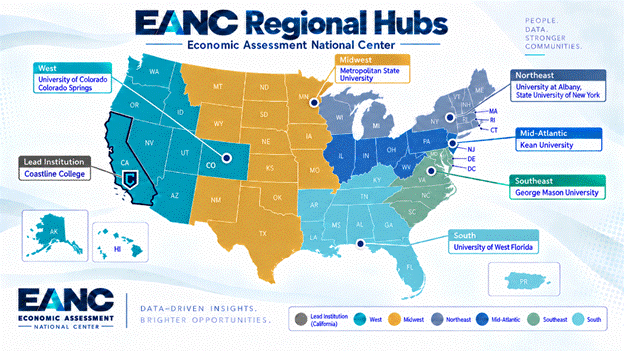
A National Effort with Regional Connections
Although EANC is coordinated nationally, its strength comes from collaboration across six Regional Hubs, each led by an institution with established cybersecurity expertise and connections to its regional community.
The participating institutions are:
These Regional Hubs will connect with CAE-designated institutions throughout their geographic areas, facilitate collaboration, gather regional perspectives, and support the development of a consistent national measurement framework.
“The regional hubs bring the national mission closer to the institutions and communities doing the work,” said Gretchen Bliss, West Regional Hub Lead at the University of Colorado Colorado Springs. “By connecting institutions across our regions, we can share experiences, strengthen collaboration, and help ensure that the national picture reflects the diverse contributions of the entire CAE community.”
Regional Hubs will host quarterly meetings to strengthen collaboration among CAE institutions and designation ceremonies to celebrate institutions that achieve or renew their National Centers of Academic Excellence in Cybersecurity designation.
Turning Data into Meaningful Impact
A central component of EANC will be the development of a Performance Measurement Framework that brings together information on cybersecurity education, graduates, industry certifications, workforce pathways, and economic outcomes.
EANC will work to minimize additional reporting burdens by making better use of existing information, establishing consistent measures, and developing tools that make results easier to understand and communicate.
The initiative will work toward national reporting and data dashboards that help institutions, regional partners, and federal stakeholders better understand cybersecurity workforce development and the broader value of the NCAE-C program.
EANC will measure return on investment while also exploring the broader return on mission: how cybersecurity education contributes to workforce readiness, institutional capacity, and national cybersecurity priorities.
EANC is designed to complement existing NCAE-C National Centers and Communities of Practice, connecting their work through a shared approach to understanding and communicating impact.
Ultimately, the goal is straightforward: Make the contributions of the NCAE-C community more visible, measurable, and meaningful.
Media Contact
Coastline College
Nicholas Robles
Public Information Officer
nrobles16@cccd.edu
(626)421-9741
Economic Assessment National Center / Coastline College
Tobi West, PhD
Principal Investigator
twest@coastline.edu
(714) 241-6020
EANC@cccd.edu
The Economic Assessment National Center is funded through the National Centers of Academic Excellence in Cybersecurity (NCAE-C) program within the National Security Agency under Award H98230-26-1-0027.